
articles
Go Back-
Articles > Boosting NHS Theatre Productivity: Why Smarter Analytics Are the Key to Sustainable Improvement
Boosting NHS Theatre Productivity: Why Smarter Analytics Are the Key to Sustainable Improvement
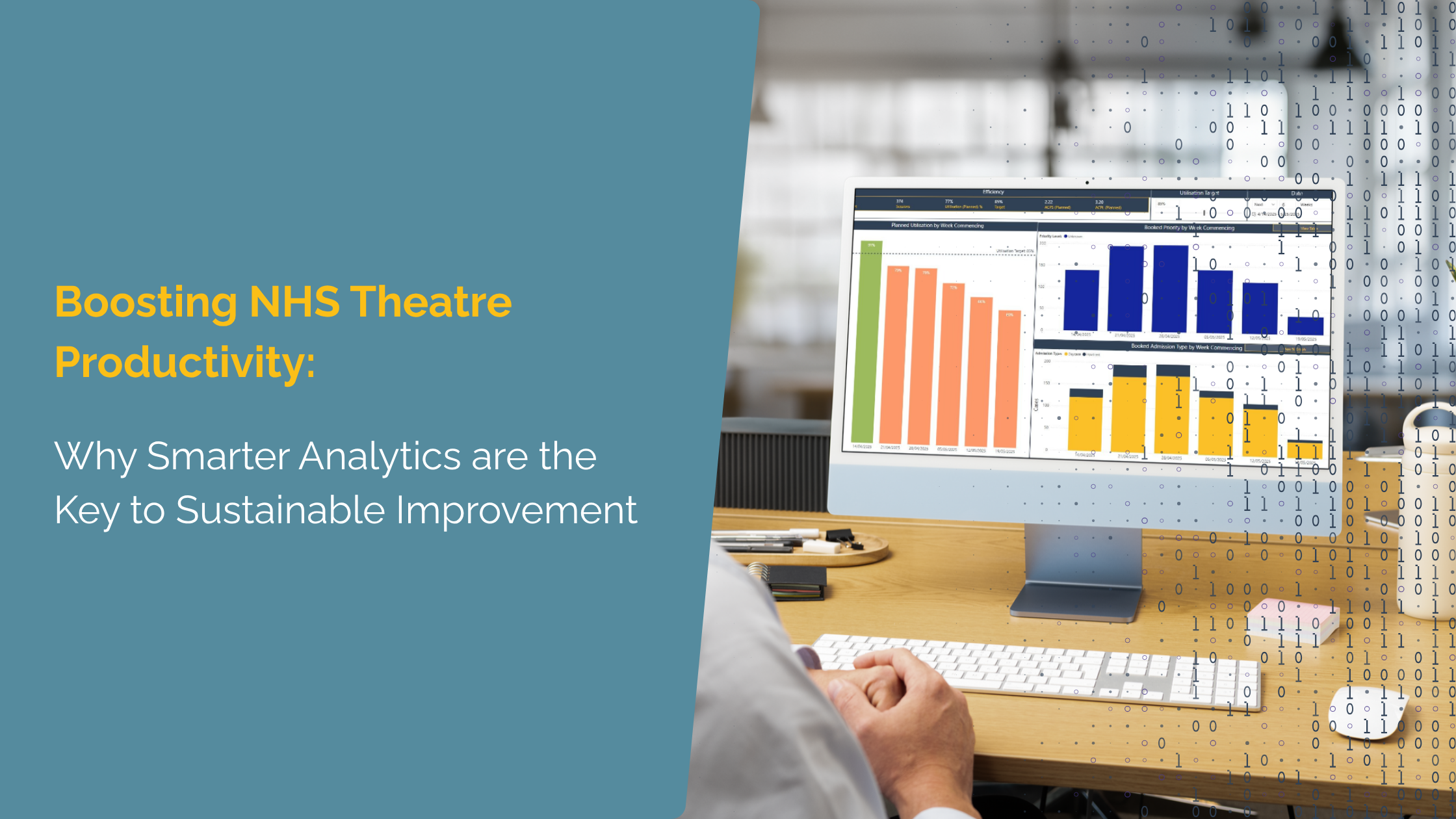
Surgical theatres are among the most valuable and resource-intensive parts of any NHS trust. When theatres run well, patients move efficiently through their pathways, waiting lists are reduced, staff experience smoother working days, and organisations maximise both capacity and financial performance. However, bottlenecks, scheduling issues, case-mix variation, or operational barriers can constrain productivity, affecting the entire hospital.
In the post-pandemic landscape, demand continues to rise and elective recovery remains a national priority. The NHS therefore needs smarter, faster, and more clinically credible ways to understand what is really happening inside its theatres.
That is where Four Eyes Insight’s Productivity Analytics comes in.
Why theatre productivity is so challenging
Theatre performance is influenced by dozens of factors: pre-operative assessment quality, scheduling timeliness, staff availability, equipment readiness, job planning, and more. Even small inefficiencies can compound into lost sessions, late starts, underutilised lists, and cancelled operations.
These challenges are amplified by what we can now see in wider elective care data. According to NHS data, the number of RTT pathways at the end of January 2026 was 7.2 million. Plastic surgery is particularly notable, with 3.3% of patients waiting more than 52 weeks, equating to 3,549 patients, with children waiting even longer.
Such pressures inevitably cascade into theatre performance, increasing the urgency for better capacity planning and operational control.
Traditional reporting often fails to capture this complexity. Data is fragmented. Dashboards can be static. And teams do not always have the specialist analytics support needed to turn numbers into meaningful improvement.
Crucially, even where data exists, it is not always trusted. Without clinical and operational validation, teams can question accuracy, challenge assumptions, or disengage entirely. This lack of confidence makes it difficult to build consensus, slowing down decision-making and limiting the impact of improvement efforts.
The result is that trusts know there is productivity potential but cannot always see where it is, how large it is, or what action to take—or secure the organisational buy-in needed to act on it.
How productivity analytics transforms theatre performance
Four Eyes Insight’s solution has been purpose-built around NHS operational realities. It combines granular analytics, clinically validated insight, and expert implementation support to help trusts understand, improve, and sustain theatre productivity.
1. A complete, clinically and operationally validated view of theatre performance
We build a robust baseline of activity, utilisation, case mix, variation, and throughput at specialty, surgeon, and theatre-suite level.
This baseline is not created in isolation. It is developed in partnership with clinical and operational teams, ensuring the data reflects real-world practice and is validated against frontline experience.
This enables trusts to identify where the real constraints lie, not just where they appear to be—and ensures that stakeholders have confidence in the findings from the outset.
This level of precision is essential. Data from Dr Foster highlights significant variation across elective pathways. Orthopaedics, for example, has a mean average wait time of 150 days. Without validated analytics, organisations risk misinterpreting where inefficiencies truly sit.
2. Deep, flexible analysis shaped through engagement
Unlike fixed dashboards, FEI shapes analytics around local challenges.
We work directly with clinicians, managers, and operational leads to explore the data, test assumptions, and interpret variation. This collaborative approach turns analytics into a shared understanding, rather than a top-down report.
Whether the issue is late starts, dropped sessions, pre-assessment flow, or theatre timetables, the insight reflects the trust’s real operational context—and is owned by the teams responsible for delivering change.
3. Modelling “what if?” scenarios to support confident decision-making
Teams can simulate the impact of different changes, such as:
- – improved scheduling
- – adjusted theatre templates
- – better pre-op readiness
- – additional lists or changes in case mix
Because these scenarios are built on validated data and co-developed with stakeholders, they provide a credible foundation for decision-making and help build consensus across clinical and operational teams.
This empowers leaders to prioritise interventions based on evidence that is both robust and trusted.
4. A structured implementation approach that builds buy-in
FEI does not just provide data. Alongside the Prism Improvement team, we support trusts through a four-phase improvement journey:
- Pre-implementation assessment – quantifying opportunity and building a shared clinical case for change
- Implementation – resolving operational barriers while embedding productivity tools
- Embedding – reinforcing ongoing performance monitoring and KPIs
- Business as usual – enabling trusts to run sustainably without external support
Throughout this process, engagement is continuous. Clinical and operational teams are not passive recipients of insight—they are active participants in shaping, validating, and applying it.
This ensures change is not just delivered, but understood, supported, and sustained.
5. Real-time insight that teams trust and use
With daily, weekly, or monthly refresh options, teams can track performance trends, spot risks early, and intervene before issues escalate.
Because the data has been clinically and operationally validated, teams are far more likely to engage with it regularly, use it to manage performance, and take ownership of improvement.
What the wider elective care data tells us
Elective care metrics offer a powerful lens on where theatre-related improvements can have the greatest system-wide impact.
Excess bed days
Across England, excess bed days, where patients stay beyond the HRG trim point, remain a major source of avoidable inefficiency. If trusts reduced just 50% of these excess days, the system could save approximately £183.8 million or free up 634,540 bed days for additional elective activity.*
This represents a major opportunity to relieve pressure on theatres by improving downstream flow.
Day-case opportunities
Nationally, the day-case rate for procedures on the BADS list averages 87.7%, but varies from 73% to 88% between organisations.*
Crucially, 429,505 patients stayed longer than one day.* Understanding whether this is due to local planning assumptions, post-operative complications, or pathway variation can unlock significant gains in both theatre and ward productivity.
Pre-operative LOS and booking pathways
Pre-operative length of stay also varies widely and may not always reflect clinical complexity, signalling further pathway opportunities. In addition, Trauma & Orthopaedics shows the highest number of cases where patients appear as elective despite entering via ED, suggesting potential booking or data-quality issues that may distort productivity baselines.
These insights reinforce why validated, specialty-level analytics—and strong engagement with the data—are essential for accurate theatre optimisation.
What this means for NHS trusts
By adopting Four Eyes Insight Productivity Analytics, trusts can expect to:
- – increase theatre throughput
- – reduce cancellations and late starts
- – improve waiting list performance
- – strengthen workforce planning and scheduling
- – make better, data-led decisions
- – build clinical and operational alignment around improvement priorities
- – embed a culture of data-driven ownership and continuous improvement
In short: higher productivity, better patient flow, and more sustainable clinical services.
Final thoughts
Boosting theatre productivity is not about working harder. It is about working smarter, with the right insight at the right time.
But insight alone is not enough. It must be trusted, validated, and owned by the teams delivering care.
FEI Productivity Analytics brings together deep clinical expertise, powerful data analysis, and hands-on engagement to help NHS organisations not only understand their theatre performance, but act on it with confidence—and deliver lasting improvement.
Click here to learn more about how our theatre programmes have supported the NHS.
Click here to learn more about Prism Improvement.
Click here to learn more about Dr Foster.
*Indicates data from Dr Foster tools