Archives

Addressing the NHS Priorities for 2022

On 24th December 2021, Amanda Pritchard, NHS Chief Executive published the NHS 2022/23 priorities and operational planning guidance which outlined the top 10 NHS priorities for 2022, many of which include objectives already set as top priorities for the Four Eyes Insight Ltd team in 2021.

In this blog post, we take a look at what will be required to realise progress towards three of the productivity-related objectives over the next 12 months and beyond.

Deliver significantly more elective care to tackle the elective backlog, reduce long waits and improve performance against cancer waiting times standards

We recently published an article outlining big-ticket items that, when addressed, are highly impactful on elevating the safe and effective productivity from your elective pathways including:

  • – Planning, testing and trialling HVLC productivity lists
  • – Examining and addressing short notice cancellations
  • – Considering standby patients
  • – Considering higher levels of productivity through superlists, parallel lists and other high productivity lists
  • – Examining the capacity and capabilities of your processes for planning for high productivity, including how effective 6-4-2 and operating list planning is
  • – Starting on time and exploring ‘First’ or ‘Golden’ patient principles – they make a difference.
  • – Measuring and reporting more effectively


You can read the full article about meeting NHS elective care targets here.

One of the specific requirements is to increase diagnostic activity to a minimum of 120% of pre-pandemic levels which is exactly what the Four Eyes Insight team modelled for NHS England and Improvement in the South East region.

Exploit the potential of digital technologies to transform the delivery of care and patient outcomes – achieving a core level of digitisation in every service across systems.

Out of necessity, we have seen an unprecedented rise of digital technology within the NHS over the last two years and there appears to be a desire to continue this trend; whilst ensuring that the effectiveness of the technology that was implemented at pace and scale during the pandemic is retrospectively analysed.

Whilst providers will be required to meet a core level of digitisation by 2025, it is hoped that many will go beyond this; embracing the potential for interoperability and data sharing to make the patient experience seamless and NHS staff more efficient.

The key to using technology for both administration/operational needs and the delivery of care is data. Data has the power to tell a story which can help identify trends, create action plans and offers a baseline to measure effectiveness. Shared Care Records and eReferral systems are key to unlocking frictionless movement of patients across health and care organisations and care pathways but we mustn’t forget that there are many unearthed stories in the operational data held by every provider and there must be a concerted effort to extract and present this information in a way which helps identify opportunities for continuous improvement.

Make the most effective use of our resources – moving back to and beyond pre- pandemic levels of productivity when the context allows this.

Pre-pandemic, a study demonstrated that productivity of the NHS improved almost two and a half times as fast than the wider economy over the last 12 years, meaning more care and treatments for patients and better value for taxpayers.

Getting back on this productivity trajectory is about more than just increasing resources – NHS organisations will need to rapidly realise efficiencies to release and make the most of existing resources. The terms ‘productivity’ and ‘efficiency’ are often used interchangeably but the guidance is clear that this objective relates to increasing the volume of care given which includes restoring core services to pre-pandemic levels and managing the elective care backlog; with payments and incentives linked to the actual level of activity delivered.

The key will be identifying areas for improvement, modelling the potential for change, understanding what interventions need to be implemented and monitoring their effectiveness so that successes can be amplified.

Whilst localised planning needs to take place to meet the needs of the local population, sharing best practice across the country will be essential to expedite productivity improvement plans.

Cross-organisational collaboration will no doubt positively impact on the effective use of resources.

Organisations must not only work together to optimise care pathways for patients and clear the elective care backlog. They must also work together to share data, identify trends and understand what good looks like.

Riding on the wave of the Global Digital Exemplars, we must embrace the role of technology within Covid-19 recovery plans to not only bring NHS services back to pre-pandemic levels, but to exceed them in pursuit of a world-leading health and care system.

Brian Wells, Managing Director and Founding Partner, Four Eyes Insight commented “It is widely published that NHS staff are under a lot of strain from the excessive demands of the past 18 months, but I have witnessed the extraordinary response to the daily challenges that clinicians and operational staff face as I meet colleagues in NHS trusts where Four Eyes Insight is in support. Elective recovery continues to be a priority in 2022, and the major challenge for providers is how they are going to manage down huge waiting lists for surgery. So, NHS Staff will need to find further resilience, as the service comes through this latest COVID wave, with greater focus on elective recovery.

 “At Four Eyes Insight, we believe that dedicated elective centres and ring-fenced elective pathways have a strategically vital role to reducing waiting lists. We have comprehensive experience in supporting trusts in planning and delivering high levels of performance along elective pathways and through those dedicated elective centres”

Brian is an expert on elective recovery with significant experience of managing highly successful elective centres of excellence.

About Four Eyes Insight

We use the combined power of people and data to get to the root cause of NHS elective care pathway inefficiencies; working collaboratively and engaging with all stakeholders to get buy in for change from the ground up. We implement interventions that optimise elective care pathways and provide tools to monitor their effectiveness ensuring that a culture of continuous improvement to drive long term, sustainable change is embedded along the way.

If you would like to find out more or discuss your requirements, please email info@foureyesinsight.com


NHS Jargon List

NHS jargon, and what’s it all about?

Healthcare acronyms are a second language, used day-to-day by NHS professionals to simplify their internal and external communications. Sometimes, this can be confusing and cause misunderstandings between healthcare professionals and audiences who are not always familiar with the technical terminology and language.

At Four Eyes Insight, our team of experts understands the importance of making information accessible, and with this, we have developed a downloadable NHS jargon cheat sheet, aimed at explaining the many acronyms within the healthcare dictionary to support with the communications within NHS teams.

Download our NHS Jargon List today.


ACU ambulatory care unit CCG clinical commissioning group
AAU acute assessment unit CNG clinical network team
ADON associate director of Nursing CSU commissioning support unit
AHSN Academic Health Science Network DHSC Department of Health & Social Care
ALOS average length of stay EBI evidence based intervention
ASG allocated steering group EDU emergency decisions unit
AST administrative support team ERF elective recovery fund
BAF board assurance framework GIRFT get it right first time
CCIO chief clinical information officer HAWB health and wellbeing board
CDC community diagnostics centre HEE Health Education England
CET clinical evaluation team HVLC high volume low comlplexity
ICB integrated care board ICP integrated care partnership
ICS integrated care system LTC long term conditions
NICE National Institute for Health & Care Excellence PCB provider collaborative board
PIFU patient-initiated follow up PPC patient pathway co-ordinator
STPS sustainability and transformation partnership TAT turn around time
TOC transfer of care

Elective Care Recovery

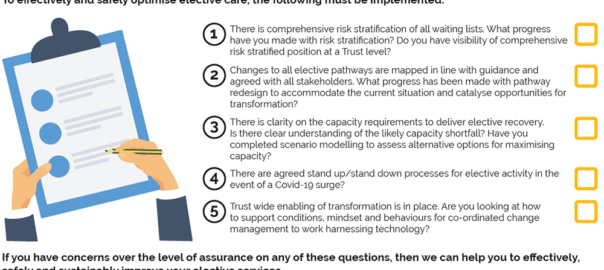
As we move into the second phase Covid-19 response, a key challenge for NHS Trusts and healthcare systems is how to address the urgency of so many patients waiting for critical procedures and appointments on elective waiting lists. Risk stratification and patient prioritisation are key as a starting point to elective recovery, alongside capturing and locking in essential pathway changes and understanding capacity constraints.

We have developed a phased approach to recovery that begins with a readiness assessment for restarting elective activity and leads onto full implementation targeting safe, deliverable and sustainable productivity improvement.

Use software to:

  • – To support data cleansing and OPCS mapping of admitted PTL
  • – To support the risk stratification process by cohorting patients based upon key risk factors   for clinical sign off
  • – To benchmark and highlight variation to national guidance
  • – To model scenarios and forecast long-term impact to support decision-making


Support safe and effective patient prioritisation by:

  • – To evidence variation against national guidance
  • – To standardise ongoing risk stratification of patients to realise robust practice
  • – To work to consistently capture the risk-stratified position
  • – To work with informatics to automate reporting of risk-stratified status
  • – To quantify theatre and outpatients demand by risk priority, considering pathway changes effected by Covid-19


Team working:

  • – To identify and remove barriers to restarting elective activity
  • – To work with diagnostic services to resolve identified blockers and ensure sufficient capacity
  • – To implement out-patients prioritisation processes and quantify appointment requirements
  • – To establish robust governance processes/ management meetings


Pathway changes:

  • – To support implementation of solutions such as closed loop facilities; block booking/batch scheduling of activity; patient testing and OP/ theatre/ diagnostic flow solutions
  • – To enable appropriate and effective digital solutions; home working and virtual consultations and straight to test pathways
  • – To centrally coordinate sign-off of alternative pathways at sub-specialty level


About Four Eyes Insight

We use the combined power of people, data, and technology to get to the root cause of NHS elective care pathway inefficiencies; working collaboratively and engaging with all stakeholders to get buy in for change from the ground up. We implement interventions that optimise elective care pathways and provide tools to monitor their effectiveness ensuring that a culture of continuous improvement to drive long term, sustainable change is embedded along the way.

If you would like to find out more about our endoscopy services or discuss your requirements, please email info@foureyesinsight.com

Click Here to download our Elective Care Recovery Brochure.

Return to Payment by Results for NHS trusts

With NHS England insisting on ‘strong’ return of Payment by Results to drive elective activity, we review the historical effectiveness of Payment by Results and what its re-introduction means for NHS trusts moving forward.

Background

Payment by Results was initially introduced by the Department of Health in 2002 as a way of reimbursing hospitals for the activity they carry out using a tariff of fixed prices that reflect national average costs. The theory behind this was that it would create a more competitive environment between providers, putting pressure on them to make best use of their capacity and improve the quality of care.

In a national survey carried out shortly after the introduction of the scheme, Payment by Results was largely deemed a success as it reduced unit costs, reduced length of stay and increased the proportion of elective care provided as day cases; all without compromising the quality of care.

But as with any policy or guidance, there is never a one size fits all approach and whilst the overall trend was positive, there was still significant variation in performance across the country.

In recognition of this, as the NHS moved towards a place-based model of care, it was determined that the Payment by Results model also needed to evolve and pre-pandemic, there was a move towards a blended payments approach. This approach did not just rely on a single payment; rather, it was a flexible framework that could reflect local requirements and feasibility at a given point in time. Different models of blended payment allow a range of payment approaches to be combined:

However, this was benched when the reality of the pandemic had materialised and NHS England swiftly moved all providers to a simplified contract to ensure they had sufficient funding to respond to the crisis. This contract was based on NHS providers receiving block contract payments on account from commissioners, in addition to income from non-NHS sources.

Re-introduction of Payment by Results

As recovery begins, the key objective of re-introducing Payment by Results in the current climate is to drive productivity; encouraging providers to reduce the elective care backlog quicker and be creative in their strategies to tackle this.

When the move was announced by NHS England’s CFO Julian Kelly, he even gave a nod to trusts to revisit local initiatives employed at the height of the pandemic to empty hospital beds including the use of hotel rooms or care homes in the absence of domiciliary care packages.

In addition to this, NHS England has agreed a deal worth up to £525m for independent providers to reserve and then potentially supply capacity to mitigate the impact on elective work if the NHS sees a surge in admissions due to the Covid-19 pandemic.

But it is going to take much more than just money and incentives to tackle the elective care backlog.

Moving away from short-termism

It is widely acknowledged that the success of an approach like Payment by Results hinges on the management and culture of the organisation in which it is implemented. Poorly designed Payment by Results implementations could in fact result in perverse incentivisation if there is a focus on short-term results or if the results are not effectively mapped out.

The onus is therefore on NHS trusts to take a long-term approach to continuous improvement alongside realising the opportunities for quick wins along the way; using Payment by Results as an incentive but acknowledging that it should not just be a driver for reducing costs.

Payment by Results presents NHS providers with an opportunity to standardise performance; to optimise care pathways and create the necessary balance of capacity and demand to drive elective care waiting lists down to pre-pandemic levels and beyond. But to do so, there must be an understanding of the performance baseline and opportunities for improvement so data is critical to this change programme.

Communication and collaboration are also key. NHS trusts must break down not only intra-organisational boundaries in the pursuit of efficiency but also cross over inter-organisational boundaries; working across integrated care systems and regions to plan capacity and demand at both a micro and macro level, therefore reducing the dependency on independent providers and taking full advantage of the internal incentives available.

About Four Eyes Insight

We use the combined power of people and data to get to the root cause of NHS elective care pathway inefficiencies; working collaboratively and engaging with all stakeholders to get buy in for change from the ground up. We implement interventions that optimise elective care pathways and provide tools to monitor their effectiveness ensuring that a culture of continuous improvement to drive long term, sustainable change is embedded along the way.

If you would like to find out more or discuss your requirements, please email info@foureyesinsight.com


How do we deliver sustainable change? – Top tips for managing a successful programme

In the next in our series of blogs, Con McGarry, a Managing consultant at Four Eyes Insight (FEI) shares his top tips into a successful programme.

 Project management is like juggling three balls – time, cost and quality.  Programme management is like a troupe of circus performers standing in a circle, each juggling three balls and swapping them from time to time.”  Geoff Reiss

So said project management trailblazer and thought leader Geoff Reiss, Mr. Programme Management to his friends! This quote perfectly captures the balance between precision and unpredictability evoked by project and programme management.  Multiple workstreams, competing priorities, risk mitigation, change management, the list goes on.  How do we at Four Eyes Insight balance these complexities to deliver successful programmes and sustainable long-term change for our NHS partners?

Here are my five top tips for managing successful projects and programmes:

1. Expect Uncertainty: While you may know the intended objectives and expected outputs of a programme, at the start it is often unclear how these goals will be achieved.  The exact path to achievement needs to be developed and translated to bring the project to life. Very often, this path will branch, U-turn, branch again and all circle back on themselves.  Change is something you need to be prepared for and is best tackled when you…

2. Plan, Plan, Plan: Give your team the best possible chance to succeed by planning how your programme will unfold at the earliest possible opportunity and plan as far as the horizon until you can’t plan any more.  Review initiation documents, get to grips with the outputs and deliverables expected by the client and offered in the engagement proposal (ensure these are the same!), and determine what good looks like.  Next, meet your team and stakeholders to discuss and get their input.  Capture all these thoughts as they will form the basis of your plan which will define your process, framework and key expectations.

3. Communication: Communication is the lifeblood of any successful programme and can be challenging.  FEI stakeholders range from operational and clinical teams to Executive sponsors and every level in between.  As such, it is important to develop a robust communications plan to ensure information and actions are shared appropriately and understood by all stakeholders.  It is equally important to apply this logic internally to communications within your delivery team.

4. Actions and Issues: Or more precisely, the management of actions and issues.  Quickly establish a robust review framework where progress is communicated, outputs are discussed, actions are agreed and issues are resolved.  These reviews, done right, should be short, sharp and focused.  This of course relies on effective administration of actions and issues where key decisions are captured and reviewed regularly to track progress and achievement.  It may sound tedious but it’s core to a successful programme.

5. Risk Management:  So important it needed its own bullet point detached from Actions and Issues, although there is a lot of crossover between the two themes.  Effectively identifying, classifying, and developing an appropriate response to risk cannot be overstated in successful programme management. Being proactive is the key to effective risk management and we at FEI invest the time in the early stages of the process and work effectively with our stakeholders to prepare each programme appropriately for risk prevention.

None of these ideas are ground-breaking but by revisiting these fundamentals and re-committing to them often, FEI are better prepared to balance the complexities of NHS projects and programmes.  By utilising the above tips we help organisations find the most effective ways to enable positive transformational change and sustain it.

To find out more about our work, please email us at info@foureyesinsight.com

How can we meet the revised elective targets as winter closes in?

There are clear expectations that NHS Trusts will stabilise their elective waiting lists and clear very long waiters by March 22. The NHS continues to face challenging times as it heads into what is predicted to be a tough winter ahead, but it will need to respond to the call for getting more done in a changing environment of expected efficiencies.

Brian Wells, Managing Director of Four Eyes Insight argues that focusing finite resources on recognized priorities will enable NHS Trusts to keep the elective pathways running as A&E creaks under the pressure of increasing attendances.

And a good place to start is to focus on those ring-fenced elective centres (Hubs) and those elective pathways which are most remote from the impact of acute medicine.

Host trusts should look for and expect higher levels of productivity through their dedicated elective centres and pathways. With staffing levels under pressure, it is even more vital that every operating session is maximized to its true potential.

We ask ourselves, why are green pathway still experiencing lower levels of utilization than prior to COVID? Why is there greater focus on providing more operating sessions and resourcing additional hours in preference to focusing on maximizing those operating lists in play?

The elective centres and ring-fenced pathways need to be the foundations for High Volume-Low Complexity (HVLC) delivery. Day case units rarely reached higher levels of productivity even before COVID materialised, so a focus on those operational factors that, when done well, move the dial on productivity and deliver more is critical to elective recovery.

So, our top tips on where to focus:

  • Plan, test and trial HVLC productivity lists. Be ambitious for your service. When staffed and managed well these operating lists are focused, buzzing environments where morale is high and expectations are clear. No one is rushed and patient safety is paramount. So explore their potential. Look to make them mainstream.
  • Examine and address short notice cancellations. Why are there patients on operating lists who no longer require surgery? It was a rare phenomenon but now an increasing issue. Launch a Task and Finish Group to get under the causes of last minute cancellations, especially on those patients where good processes would intercept and reduce these.
  • Consider standby patients. There are many patients out there who will be willing to come in on short notice, so plan for this.
  • Consider higher levels of productivity through superlists, parallel lists and other high productivity lists. These allow for much greater throughput and maximise the use of existing theatre stock and available sessions. Explore their potential.
  • Examine the capacity and capabilities of your processes for planning for high productivity. How effective is the 6-4-2 and operating list planning? Can it deliver on expectation? Are your operational and reporting process responsive to high levels of productivity?
  • Start on time. So many operating lists start significantly late so plan and expect to get things underway to ensure the available surgeon time is maximised. This is very possible, although it needs a strong focus and pathway discipline to ensure the pre surgical planning tasks are completed. Explore ‘First’ or ‘Golden’ patient principles, they make a difference.
  • Measure and report. Ensure your operational teams have sight of the impact of what they do. Look back on recent performance, challenge, address and resolve repeat issues. Push through custom and practice in favour of evidenced based performance. Call out success.

There are clearly other issues and processes to address but these are some of the big-ticket items that, when addressed, are highly impactful on elevating the safe and effective productivity from your elective pathways.

At Four Eyes Insight, we really know how to turn up the dial on elective productivity. We work alongside your clinical and operational teams at pace and with absolute focus on the things that make the difference.

If we can help to transform your theatre efficiencies, please do get in touch by email info@foureyesinsight.com or visit www.foureyesinsight.com.