Archives

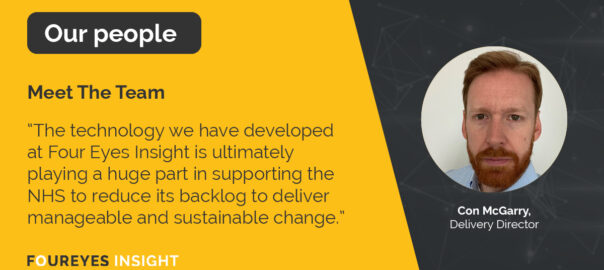
Meet the team: Con McGarry

As part of our team spotlight series, last month, we spoke to Four Eyes Insight’s incoming Managing Director Lee Scothern about his role and vision for the business.

This month, we spoke to newly appointed Delivery Director, Con McGarry about his Four Eyes Insight journey, his passion for developing talent and his plans to enhance sustainable patient care pathways.

Background

With a Biomedical Sciences degree from the University of Westminster, Con spent the first five years of his career as a Biomedical Scientist in NHS pathology labs before moving into the world of consulting.

His initial consulting role was centred around his pathology specialism where he was responsible for the integrated performance management function across the clinical pathology service. As part of this role, he led a  public-private partnership programme involving Guy’s & St. Thomas’ Hospital Foundation Trust and King’s College Hospital Foundation Trust. During this time, Con also completed an MBA in Business Administration, Strategy,  Economics and Finance.

Following this, Con held product, operational and executive management roles within the mobility tech sector before moving back into healthcare in 2018 via an AI backed medical transcription SaaS organisation where he held the role of Director of Operations.

During the pandemic, Con went back to his pathology routes to provide expert insight, knowledge, and advice to support the implementation of healthcare policy and process within Covid-19 testing facilities.

Since joining the Four Eyes Insight team as Managing Consultant in 2021, Con has led a series of improvement programmes for NHS organisations in support of clearing waiting lists and backlogs.

More recently, Con was appointed as Four Eyes Insights Delivery Director, leading in strategic consulting, overseeing resource to meet the businesses demands, and maintaining sustainable workflows across the organisation.

What attracted you to the FEI team?

“I was instinctively attracted to the aligned ethos Four Eyes Insight and I shared. The business values, were then, and are still now, reflective of my experience of working within the healthcare sector, and this was a real pull for me when applying for the role.

“Whilst working as a biomedical scientist within the NHS, I was aware that with each investigation I performed, there was a patient at the end of the result whose care was impacted. Since moving into a more customer focused career, this has stayed with me, and it has been clear from day one of joining the Four Eyes Insight, that our work has one main goal – to improve patient experience.

“An additional driving force for me was the ethical and sustainable practices at Four Eyes Insight. These practices rang true to for me when learning more about the company, as I have adopted many similar values and practices throughout my career in consulting.”

What is the most rewarding part of your job?

“It’s the confidence I have knowing that our output is making a difference to patient pathways and understanding that the improvements we are putting in place are having a positive impact on patient care and driving down waiting lists.

“I always relate our work back to my own experiences and those frustrating experiences I hear of though my friends and family, regarding the inadequacies and inefficiencies within the healthcare sector. The technology we have developed at Four Eyes Insight is ultimately playing a huge part in supporting the NHS to reduce its backlog to deliver manageable and sustainable change.

“Not only is our output rewarding, but internally the team at Four Eyes Insight, make each day in my job interesting. Working alongside renowned specialists, recognised and nationally renowned specialists, we understand that it’s our people and their knowledge that underpins everything we do, and I am incredibly proud to be a part of that.

“Further to this, an initiative that is supported by Four Eyes insight is the continued focus on helping people to reach their full potential, developing both personally and professionally. I really admire that as a team we are passionate about internal development whilst also recruiting next generation talent.”

Why do NHS trusts work with Four Eyes Insight?

“NHS trusts are attracted to our team because we act as extension of their internal operations. We have an organic approach to consulting as we work with the trusts, side-by-side. Despite there being a stigma around consultants delivering recommendations and walking away, we act as an critical friend and sounding board, working alongside NHS teams to seamlessly deliver their goals and objectives whilst building relationships so that they can feel comfortable in coming to us for support and ongoing guidance.

“A big pull for most trusts is that we are extremely dynamic in our approach, and if there is an obstacle along the way, our team work quickly to resolve this, while providing expert solutions. We don’t have a cookie cutter programme; so, this sets us aside. Our teams build and tailor bespoke plans for trusts so that we can be flexible when it comes to planning deadlines and timelines.

“Our Executive Chair Brian Wells describes us perfectly – as a family.  Our human centred approach and empathy towards our clients and their unique challenges and situations is what enables us to build long standing relationships, and this is what sets us apart from other traditional consultants. As we are all working towards the same goals and objectives, we become aligned from the word go.

“As mentioned previously, the fact that the majority of our consultants come from an NHS background and are nationally renowned specialists in their fields is a key driver for trusts, as they know that we understand their environments, training and culture.”  

What are the potential opportunities for NHS pathology laboratories and teams?

“I don’t think a lot of people had really heard of pathology prior to 2020 and then suddenly, it’s one of the hot topics in the NHS as we coped with the demands of the pandemic.

“Like many NHS services, pathology services are often fragmented, but with 1.2billion tests performed per year, covering around 95% of all clinical pathways, pathology services have the potential to help significantly reduce the elective care backlog ensuring patients move through the system quicker and are not having lengthy waits for test results, which may degrade the quality of patient care and increase the level of clinical contact required.

“In line with Lord Carter’s Review of the NHS Pathology Services in England and the subsequent report on Operational productivity and performance in English NHS acute hospitals: Unwarranted variations, pathology services need to become more efficient. They require consolidation and a networked approach to reduce the level of variation in tests, ensuring there is a consistency of patient experience from NHS trust to trust.

“In 2019, 97% of NHS trusts had started the journey towards implementing the recommended ‘hub and spoke model’ outlined in both reports however, progress was halted during the pandemic so the vision to create 29 pathology hubs by 2021 was not quite realised. Momentum needs to be regained with this to ensure services and their outputs are standardised.

“NHS trusts must also look to implement a performance management framework like the GIRFT Clean Framework to ensure that the right test is carried out at the right time, with the right answer for each patient. The implementation of this framework will require extensive changes to the systems that support pathology labs and enable their work, particularly as there are many scientists that have worked their way up to management positions without any formal training, who require support on projects of this nature. This is what really interests me about supporting in this area as I think we’re in the ideal position to effect that sustainable change.”

What do you like to do in your spare time?

“Outside of work I’d like to say that my weekends are wild, and they are to some degree, those wild weekends tend to be looking after 2 young children, who dominate mine and my wife’s time with numerous activities. However, when not out with the kids I enjoy regular exercise, such as running and football.

“I absolutely love film, and TV, most evenings my wife and I sit down to watch the latest drama, which is my time to relax.”

About Four Eyes Insight

We use the combined power of people, data, and technology to get to the root cause of NHS elective care pathway inefficiencies; working collaboratively and engaging with all stakeholders to get buy in for change from the ground up. We implement interventions that optimise elective care pathways and provide tools to monitor their effectiveness ensuring that a culture of continuous improvement to drive long term, sustainable change is embedded along the way.

If you would like to find out more about our endoscopy services or discuss your requirements, please email info@foureyesinsight.com




How data can help reduce cancer patient backlogs

With high levels of referrals and an ever-growing backlog, the number of patients seen following an urgent suspected cancer referral has remained at a record high since March 2021.

To compound the situation, a staggering 36,000 additional patients were expected to have come forward to start cancer treatment during the pandemic than having done so, according to the NHS 2022/23 priorities and operational planning guidance.

As a priority, NHS organisations are expected to:

  • – Improve performance against all cancer standards, with a focus on the 62-day urgent referral to first treatment standard, the 28-day faster diagnosis standard and the 31-day decision-to-treat to first treatment standard.
  • – Meet the increased level of referrals and treatment required to reduce the shortfall in number of first treatments.


The need to improve performance against cancer standards whilst simultaneously dealing with the consequential effects of the pandemic will be challenging for many; requiring a strategic review of resources, the workforce, processes and procedures to work through the backlog and achieve these priority objectives.

Reducing delays in diagnosis to drive improved outcomes

Improving access to diagnostics is high on the list of priorities. The introduction of the 28-Day Faster Diagnosis Standard in 2020  (FDS) was greatly impacted by the pandemic is designed to ensure that patients find out within 28 days whether or not they have cancer, will have a greater focus.

A report by Professor Sir Mike Richards outlined the need for community diagnostic hubs that offer tests for emergency and elective diagnostics, outside of a hospital to reduce hold-ups for patients and provide a safer COVID free environment to those at risk.

“Not only will these changes make services more accessible and convenient for patients but they will help improve outcomes for patients with cancer and other serious conditions.”

Professor Sir Mike Richards, Chair – Independent Review of Diagnostic Services for NHS England.

The implementation of these hubs should add much-needed capacity for diagnostics, but this can only be successful if there is the workforce to support it, along with a full understanding of the demand and ability to sufficiently plan capacity.

Data is king for demand and capacity

With multiple and sometimes complex diagnostic and treatment data points available, one of the most integral success factors for cancer pathway planning is having a clear view and understanding of service demand in order to align it with capacity. Information about what resource is available along with where it can be deployed and when needs to be readily accessible for NHS trusts to have a chance of diagnosing cancer patients within 28-days (FDS), treating them promptly and safely, and discharging them when ready.

“The issues we’ve seen first-hand are about capacity, productivity and data” says Debbie Johnston, Endoscopy Subject Matter Expert and Products Director at Four Eyes Insight. “Working efficiently, in the best way, utilising the resources that you have got is crucial. But the workforce and physical capacity, with outpatients, diagnostics, theatres and oncology have been severely hampered as we still recover from the pandemic.”

With data playing such a crucial role in the planning process, here’s five questions to help you identify opportunities for improvement and establish whether you could improve access to the information you need:

  1. 1. Do you have control over and access to the data?
  2. 2. Is all your data aggregated in one place to make it accessible and help you identify trends?
  3. 3. Can you easily monitor performance over time to demonstrate continuous improvement?
  4. 4. Do you have the capacity and capability to do a deep dive into the sub-components of the data?
  5. 5. Are you able to map out the patient pathway to identify why patients are waiting and what the blockages are?

How Four Eyes Insight can help

As providers continue to work toward elective recovery and reduce waiting lists, Four Eyes Insight is here to help. We use the combined power of people, data and technology to get to the root cause of inefficiencies; working collaboratively and engaging with all stakeholders to get buy-in for change from the ground up. We implement interventions that optimise elective care pathways and provide tools to monitor their effectiveness ensuring that a culture of continuous improvement to drive long term, sustainable change is embedded along the way.

Working in collaboration with an NHS Trust in the South East, our team had a rapid impact on the cancer pathway that helped to:

  • – Reduce the cancer backlog by 40%
  • – Increase 62-day compliance by 27%
  • – Reduce 104-day breached by 44%
  • – Reducing significant harm to patients


For more information. please email info@foureyesinsight.com.

Standardising elective care performance and reducing variation within an ICS

In pursuit of elective care recovery across the country, the formation of Integrated Care Systems (ICS) not only provides the opportunity to work collaboratively to tackle the backlog but also to level the playing field and reduce what’s known as the ‘postcode lottery’ when it comes to the delivery of care.

Within an individual ICS, the proactive optimisation of elective care pathways will undoubtedly contribute to meeting the targets set out in the elective care recovery plan by March 2025. But the real opportunity perhaps lies in working across ICS boundaries; to pool resources from both a capacity and capability point of view and maximise elective activity on a wider scale.

This was echoed at a recent round table event held by The King’s Fund, where participants explored the relationships that would be critical to successfully managing the elective care backlog including intra- and inter-organisational collaboration, local community and patient engagement, co-ordination between primary and secondary care and the role of data in the elective care pathway.

This event highlighted the opportunities to:

  • – Share resources and innovation to support neighbouring systems, particularly where waiting times are longer in some areas than others.
  • – Ensure the NHS workforce across the system is engaged with the elective care journey and empowered to create positive change that will support the road to recovery.
  • – Consider the role of data in patient stratification with the potential to bring in markers such as levels of deprivation or social value that may contribute to improved outcomes further down the line.


Optimising elective care pathways

Working with NHS regions, systems and trusts across the country, Four Eyes Insight is supporting the reduction of the elective care backlog by aligning capacity with demand; using data in conjunction with our technology and expertise to identify and implement sustainable productivity gains whilst helping trusts get back to basics done well.

Within an ICS, our programme of works can be tailored to involve one or multiple trusts; bringing them together through the uniform management of waiting lists, distribution of capacity and improved patient experience from referral to discharge.

Our experienced productivity consultants work as an extension of NHS teams to deliver real value and sustainable change, implementing data-driven decision making into the continuous improvement process.

Our methodology is based on taking a holistic view of the elective care pathway and identifying service improvements and productivity gains at every possible touchpoint.

Providing ICS-wide visibility of elective care performance

To support Four Eyes Insight’s programme of works, our data dashboard brings all your elective care performance and variation data from across the ICS into one central location, delivering system-wide benefits:

  • – Providing clear visibility of performance against targets, both strategic and operational views
  • – Rapidly identifying areas of concern to reduce variation within the ICS
  • – Encouraging cross-organisational collaboration with a simultaneous focus on efficiency and quality
  • – Providing the opportunity to share learnings and best practice to amplify and standardise operational performance across the system
  • – Enabling positive stakeholder engagement in your continuous improvement programmes
  • – Supports governance and compliance frameworks


The manual process of aggregating performance data to monitor elective care recovery is a laborious task but our Insight Portal provides immediate productivity gains through the automation of ICS-wide data collection and aggregation.

About Four Eyes Insight

As providers continue to work toward elective recovery, Four Eyes Insight is here to help.

We use the combined power of people, data and technology to get to the root cause of NHS elective care pathway inefficiencies; working collaboratively and engaging with all stakeholders to get buy in for change from the ground up. We implement interventions that optimise elective care pathways and provide tools to monitor their effectiveness ensuring that a culture of continuous improvement to drive long term, sustainable change is embedded along the way.

If you would like to find out more or discuss your requirements, please email info@foureyesinsight.com

Download the guide to learn more about how Four Eyes Insight can support your Integrated Care System.


Improving utilisation of ringfenced elective care services

It has long been a GIRFT (Getting it Right First Time) recommendation to ring-fence elected beds whether for day surgery or for inpatients; or to have a stand-alone elective unit to provide the opportunity to protect those beds and use them more efficiently. Not only can this support the flow of patients through the elective pathways, but this also reduces the risk of post-operative infections as emergency medical patients that are routed elsewhere and can’t introduce infections onto what should typically be a ‘clean ward’. Early into the pandemic, this became challenging as wards were re-purposed to house Covid-19 patients with surgical and support staff within the NHS sometimes redeployed to support the Covid-19 response.

In October 2020, published data from the Royal College of Surgeons of England, in support of ‘protecting surgery through a second wave’ led to calls from surgeons to ring-fence hospital beds for planned operations. In some areas, the move towards this has been slow, this is due to the operational logistics and infrastructure updates required to bring about this change.

Subsequently, the long-awaited elective care recovery plan that was published in February 2022 outlined the need to create a new and extend existing surgical (or elective) hubs which would provide a clear separation between the urgent and elective care pathways, and also free up capacity to deliver high-volume, low-complexity (HVLC) surgery.

Despite fast tracking elective hubs,  with many already in operation, we are still seeing a significant number of breaches and under-utilisation within these ring-fenced services. This is often caused by the merging of elective and medical pathways to cope with higher acute demand which also exacerbates operational inefficiencies in the management of these hubs as the ring-fenced beds no longer stay ring-fenced.

How Four Eyes Insight can support

As providers continue to work toward elective recovery, Four Eyes Insight are here to help. We use the combined power of people, data and technology to get to the root cause of NHS elective care pathway inefficiencies; working collaboratively and engaging with all stakeholders to get buy in for change from the ground up. We implement interventions that optimise elective care pathways and provide tools to monitor their effectiveness ensuring that a culture of continuous improvement to drive long term, sustainable change is embedded along the way.

If you would like to find out more or discuss your requirements, please email info@foureyesinsight.com


Tired surgeon after the operation

Revealed: NHS Staff Survey Results 2021

NHS England published it’s 2021 Staff Survey last month, with results emphasising the demand and challenges faced by NHS employees.

The survey which was completed by over 648,000 NHS employees saw a widespread dip in numbers from previous years but positive responses around team working highlight the togetherness of staff –  81.4% enjoy working with their colleagues in their team and 71.3% feel that team members understand each other’s roles.

Interestingly, with public satisfaction dropping to its lowest point in 25 years, it seems NHS staff are tending to agree, with only 67.8% of employees being happy with the standard of care provided by their organisation – a 6% decrease from 2020.

Key trends include:

  • – Increase in stress and burnout
  • – Notable increases across work pressure and workload
  • – Negative staff experience with low staff engagement
  • – Staff attending work when unwell
  • – A decline in health and wellbeing measures


Investing in the Workforce

One of the priorities set out in the NHS 2022/23 priorities and operational planning guidance is to ‘invest in the workforce – with more people and new ways of working, and by strengthening the compassionate and inclusive culture needed to deliver outstanding care.’

Recruitment and retention of NHS staff is becoming increasingly difficult with the latest statistics showing nearly 100,000 NHS vacancies (nearly 70,000 of these in the Acute sector) and a vacancy rate of 7.6%.

Staff engagement is currently lower than in previous years, scoring 6.8 points, but prior to the results of the survey, the planning guidance had already outlined several operational targets to support the health and wellbeing of staff, improve belonging, work differently and grow for the future; culminating in the vision to make the NHS a more desirable place to work, showing they are already understanding of the need to improve the way of working for staff.

Enabling NHS staff

A key theme here will need to be ‘enablement’ – how do we ensure NHS staff have the tools, interactions and communication to enable them to work more effectively? Currently, only 53.1% feel able to make improvements happen in their area of work, which has been declining over the past few years and over half of the respondents (55.1%) are able to access the right learning and development opportunities when they need to.

Possibly the most worrying of all stats is that almost half (46.5%) of the respondents said they feel worn out at the end of their working day/shift. If the NHS is there to look after the population, who is going to look after the NHS?

Whether it’s streamlining processes or introducing new technology, improving the productivity and efficiency of the NHS will be critical to maintaining the interest and motivations of the workforce.

We know that organic change within the NHS is notoriously slow but it is clear that change will need to be expedited in order to keep up with market forces that are currently luring NHS staff away from the institution.

Supporting the NHS workforce

One of the reasons Four Eyes Insight exists is to work shoulder-to-shoulder with the NHS to identify inefficiencies and implement improvement plans for sustainable change, empowering the workforce to have confidence that they are able to meet – or even exceed targets set out by the NHS.

Our people are experts in their respective fields, combining clinical and operational expertise to deliver data-driven improvements to the NHS.  Many of our consultants have held NHS roles before joining Four Eyes Insight, giving us a unique view of the operational challenges that need to be resolved.


To learn more about the NHS staff survey, click here.


Six top-tips for implementing PIFU

In recent years, there has been growing interest in Patient-Initiated Follow-up (PIFU) to manage outpatient demand. In 2018, a report by the Royal College of Physicians ‘Outpatients: The Future’, recommended PIFU as one of the ways in which to modernise outpatient care, and in particular allow “patients more control over when and how they receive care”. Indeed, the PIFU approach gives patients and their carers the opportunity to initiate their own follow-up appointments as and when the patient needs them, thus enabling self-management and shared decision-making. In practice, routine appointments for eligible patients (which can be inconvenient, stressful and an unnecessary expense) are replaced with on-demand appointments driven by symptoms or complications.

With an increasing number of outpatient appointments year after year, we have seen a shift from PIFU simply being a recommendation. Rather, in recent NHS guidance, providers are now being explicitly asked to implement PIFU. Further, PIFU now forms a key part of the NHS Outpatients Transformation Programme and the NHS’ response to the Covid-19 pandemic. In ‘Implementing Phase 3 of the NHS Response to the Covid-19 Pandemic’ the NHS provided detailed implementation guidance on PIFU.

Targeted investment funds have been made available with providers asked to propose a “shortlist of targeted investments that can deliver in year and have a material impact” where the focus should be on “delivering the highest priority elective recovery reforms” “and/or” on “systems and providers facing the greatest challenges in restoring activities to pre-pandemic levels.”

Clearly, PIFU should be a key consideration in providers’ elective recovery strategy. Nevertheless, the implementation of PIFU can be complex, requiring careful selection of appropriate pathways and patients, a re-design of current processes, as well as engagement with broad range of stakeholders. But where it is successfully implemented, PIFU can bring a range of benefits to providers, clinicians, but most importantly to patients.

Why use PIFU?

For providers, PIFU helps to reduce the demand for routine follow-up appointments, and in turn helps to manage service waiting lists. Evidence has shown that approximately 80% of patients on a PIFU pathway do not call back for an appointment that they would have routinely received. This is important when we consider that in 2019-20 there were 125 million outpatient appointments in England, a 66.9% increase from 10 years ago. This huge demand for outpatient services has created long waiting lists, with an estimated record high of 7.5 million waiting for hospital treatment in May 2023.

Where outpatient appointments are scheduled, Did Not Attends (DNAs) are a pertinent issue with an estimated 1 in 5 appointments resulting in DNAs. By allowing patients to take ownership of arranging their follow-up appointments, PIFU can also help to reduce DNA.

Alongside empowering patients, the benefits of PIFU for patients can also include a reduction in unnecessary visits to the hospital and the associated burdens including, needing to arrange childcare, taking time off work, and travel.

For clinicians, PIFU can release time to dedicate to more complex patients and those waiting for their initial appointments, as well as allow the clinician and patient to jointly develop the patient’s clinical plan.

Successfully Implementing PIFU: Six Top Tips

Given the intricacies that need to be considered within each patient pathway, successfully implementing a safe and sustainable PIFU model requires robust project management and clinical engagement from the offset.

Here is a summary of some of the key elements of our step–by–step implementation plan and top tips for a successful launch.

  1. 1. Engage – Host engagement sessions with clinical teams from the offset to agree on appropriate PIFU pathways and patient inclusion/exclusion criteria. Set up regular touchpoints with the clinical teams and operational managers to keep them up to date with progress throughout and to ensure they are fully signed up for key decisions. Other key stakeholders to engage with include patients, booking teams, IT teams and primary care.
  2. 2. Agree on the approach – Standardising the approach to implementation is crucial to ensure consistency across the organisation. A multidisciplinary Task & Finish group can provide a forum for agreeing on key steps of the implementation such as roles and responsibilities, comms material, booking rules, contact method for patients, outcoming considerations and reporting metrics and methods. Moreover, it can provide oversight and scrutiny to the implementation process and ensures risks and issues are escalated and dealt with, reducing blockers within the system and saving time. But don’t forget to allow the flexibility for individual pathways to be tailored to meet the clinical needs of each patient group – 1:1’s with the speciality leads will also be critical to the long-term success of and buy-in to the new PIFU pathways.
  3. 3. Pilot the process – Have in place pre and post-go-live checklists to support the launch of the new pathways. This helps ensure that all key requirements are met before the pathways go live. It is recommended that you go live with a few pathways initially to gain a better understanding of what is working well and what is not before any wider roll-out. And don’t forget to report the outcomes!
  4. 4. Measure success – Ensure you document baseline performance metrics so that you can evidence the significance of the change implementing PIFU has made over time.
  5. 5. Digitisation – If it is not already on the agenda, a long-term digital solution to support the PIFU process is highly recommended. Make the process more efficient with a patient portal which can host patient information, as well as allow patients to book appointments, and perhaps monitor long-term conditions by recording symptoms. Digitalisation will streamline the process and reduce the burden on clinical and support teams.
  6. 6. Extend PIFU to Follow-Up Backlogs – Identifying and moving existing backlog patients to PIFU can free up much-needed capacity. Carrying out an administrative search of letters on the Patient Administration System (PAS) can provide a subset of targeted patients for clinical triage to determine the patients suitable for the PIFU pathways.

How Four Eyes Insight can Support

As providers continue to work toward elective recovery and the implementation of PIFU, Four Eyes Insight is here to help.

We’ve already helped a number of Trusts and Health Boards set up their PIFU pathways, with some impressive results, including:

  • ✔️ 34 against a target of 28 SOS/PIFU pathways rolled out
  • ✔️ 80% anticipated saving of at least 4,510 follow-up appointments
  • ✔️ 1608 patients on the waiting list had undergone administrative triage and were awaiting clinical sign-off as suitable for SOS/PIFU at project close
  • ✔️ 851 suitable SOS/PIFU patients added to the follow-up waiting list


We use the combined power of people, data and technology to get to the root cause of NHS elective care pathway inefficiencies; working collaboratively and engaging with all stakeholders to get buy-in for change from the ground up. We implement interventions that optimise elective care pathways and provide tools to monitor their effectiveness ensuring that a culture of continuous improvement to drive long-term, sustainable change is embedded along the way.

If you would like to find out more or discuss your requirements, please email info@foureyesinsight.com


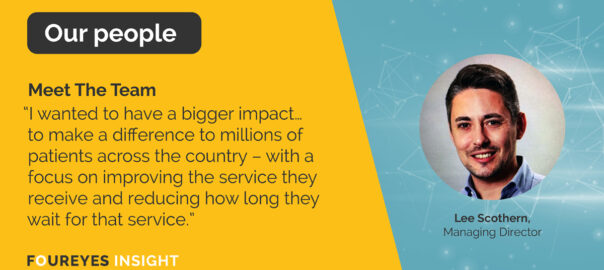
Meet the team: Lee Scothern

Following on from last month’s spotlight on Four Eyes Insight’s Endoscopy Subject Matter Expert Debbie Johnston, this month, we spoke to incoming Managing Director Lee Scothern about his NHS background, service transformation, his people-centred approach to management and ­­passion for helping the NHS clear the elective care backlog.

Background

Having always been passionate about helping people, Lee started his career in 2005 as an NHS Theatre Support Worker where he worked for two years before moving into an Associate Nursing Practitioner role within an operating theatre department. He supported many procedures during his nine-year tenure, including upper and lower gastrointestinal, colorectal, gynaecology, urology and some light vascular surgeries.

Lee’s next career move was into a transformation lead role for the surgical division at the NHS trust he’d spent the last nine years at. He worked to transform patient care; scenario planning around current and potential theatre pathways to explore the art of the possible in terms of productivity improvement. Lee’s focus was around how theatres could better integrate with day case wards, admissions and pre-assessment services, all in pursuit of improving patient flow and experience. He also worked on an award-winning project to reduce same-day cancellations, having been instrumental in bringing together both clinical and operational teams in order to drive improvement.

During his time as transformation lead, Lee worked with the Four Eyes Insight team on an orthopaedic project where he witnessed first-hand the impact the team made, following which, he had re-engaged with them for a wider piece of work on other surgical specialties based on the results.

Soon after, in 2016, Lee transitioned over to the Four Eyes Insight team working his way up from a Consultant (Theatres Subject Matter Expert) to a Senior Consultant, Delivery Lead, Managing Consultant and Consulting Director. More recently, Lee has moved into the position of Managing Director, taking the reins from now Executive Chair Brian Wells.

What attracted you to the FEI team?

“During each stage of my NHS practitioner career, it was all about making a difference for one patient at a time – giving our entire focus to them before moving onto the next patient. As I moved out of my scrub role into a transformation role, I was able to make a difference on a wider scale but still within the community and geographical area served by the NHS trust I worked for.

“I wanted to have a bigger impact… to make a difference to millions of patients across the country – with a focus on improving the service they receive and reducing how long they wait for that service.

“The Four Eyes methodology and the use of data to help identify opportunities for improvement made an immediate impression on me. Improving productivity wasn’t just a case of asking clinicians to go quicker, efficiency gains were much more multi-faceted, and Four Eyes Insight had proven experience in implementing successful improvement programmes to help realise this.  

 “As soon as I joined Four Eyes Insight, I knew I’d made the right decision. I loved the ethos of the organisation; how approachable the team were and the respect that everyone showed each other. I also valued the fact that everyone had an input into the business which even after a period of growth is something that has been maintained.

“But the main thing that made Four Eyes Insight stand out from other consultancies was the fact that much of the business has been there and done it. We have a multidisciplinary team which includes general consulting, data analysis and programme management expertise, augmented by a wealth of clinical and operational NHS experience. As a result, we can be authentic in our engagements – we can say “I’ve been there, I feel your pain”, and that helps us get immediate buy in from programme stakeholders.”

What is the most rewarding part of your job?

“Undoubtedly it has to be the impact we have – the immediate change in practices and behaviours which leads to long-term sustainable results. I get a buzz out of implementing a programme and retrospectively analysing the impact we’ve had, much of which is often achieved under incredibly challenging circumstances.

“Over the years, this has enabled me to forge amazing relationships and build strong networks – I can reach out to any of my previous clients for catch up because the bonds and relationships that we build when delivering great work and sustainable change in the NHS are long-lasting.

“When I think about the programme that I’m most proud of, I’d have to say working with a specialist trust in the North West to drive utilisation improvements in outpatients and cath labs. The benefits we realised were sustained over time and the client is still reaching out to look at future work.

“I also can’t ignore the sense of achievement I get from supporting the Four Eyes Insight team… seeing people join the organisation and move up the business just as I have is incredible and testament to the culture and ethos we’ve built.”

Why do NHS trusts work with FEI?

“There is a great synergy between our personalities and those within the NHS and a lot of our success is driven by this. From our initial meetings, the rapport we build is critical to the ongoing relationship and because we have lived experience of the challenges many of our clients face, we’re able to more easily get to the root cause and bring people on the journey.”

“Ours is a consultative sales process and we’re not a pushy consultancy. Sometimes, we’re in discussions with an NHS trust for over a year before they commit to working with us but this means that when they do take that leap, we’ve already lived some of that journey with them and built up a mutual trust. These last two years in particular, NHS organisations have had other priorities but as we move into this elective recovery period, our clients know we’re always there for them when they’re ready to move forward.”

What are the common challenges experienced by NHS theatres teams?

“Theatre utilisation is not solely down to the theatres themselves so there is a lot of dependency on other areas of operations including pre-assessment, scheduling and patient communication – the whole pre-operative part of the pathway is where a lot of organisations experience problems.

“This can be resolved by implementing robust pre-assessment processes… creating more effective patient scheduling systems; implementing the 6-4-2 theatre planning process; ensuring patients have enough notice for their appointment; and following processes and procedures around things like annual leave.  

“Questions that need to be asked include:

  • – How are you starting the day?
  • – What time do your clinicians arrive?
  • – Do you have ring-fenced elective bed capacity?
  • – Are you implementing golden patient rules?
  • – Do you have the confidence that you’re going to have a bed available post-surgery?
  • – How have you aligned capacity with demand?
  • – Have you done everything possible to facilitate prehibilitation?


“NHS trusts need to think differently about how they see and treat the patients and as we move out of ‘pandemic response mode’ into ‘elective recovery mode’, most trusts haven’t had the headspace to contemplate that yet.  

“That’s where we can help, whether it be implementing GIRFT recommendations, optimising Patient Treatment Lists (PTLs), consideration of HVLC lists or moving procedures out of theatres into treatment room settings or community settings; there are many ways in which we can contribute to improving productivity and clearing the backlog.”

How does what Four Eyes Insight do translate to a wider scale, at ICS or regional level?

“Working upwards from an acute trust, the collaboration between NHS organisations and other providers is key to success. There needs to be clear visibility of what capacity look like across the system; how you can treat certain specialities through elective hubs and what those hubs look like to achieve the aspirant utilisation.

“With additional capacity available within the private sector, NHS organisations also need look much further than their own patch. Private sector capacity is paid for whether trusts are using it or not and current scheduling systems don’t necessarily consider this.

“But the most important consideration across a system will be a shared vision. There should be an agreed programme of works with clear KPIs so that everyone understand the potential throughput expectation that can be measured on an ongoing basis.”

What does the new Four Eyes Insight Managing Director do in his spare time?

“I’m a family person. I love spending time with my partner, friends and family and especially enjoy sharing a good meal.

“I also love travelling and feel strongly about making time for holidays. After two years of travel disruption, we’re looking forward to an exciting road trip to America this year… starting in Las Vegas and making our way through Yellowstone, Jackson Hole and Denver!”

About Four Eyes Insight

We use the combined power of people, data and technology to get to the root cause of NHS elective care pathway inefficiencies; working collaboratively and engaging with all stakeholders to get buy in for change from the ground up. We implement interventions that optimise elective care pathways and provide tools to monitor their effectiveness ensuring that a culture of continuous improvement to drive long term, sustainable change is embedded along the way.

If you would like to find out more about our endoscopy services or discuss your requirements, please email info@foureyesinsight.com


Are virtual wards the key to clearing the elective care backlog?

Elective care planning requires clinical and operational capacity to be aligned with demand. Whilst ineffective workforce and theatre planning can impact a trust’s ability to maximise capacity, hospital bed availability is also significantly impacting the flow of patients through elective care pathways.

Freeing up hospital beds

Delayed transfers of care (DTOCs) have long been a problem for the NHS with an estimated 1 million ‘lost bed days’ per annum at an average cost of £640,000 per day or £27,000 per hour. Beyond the financial impact, DTOCs can negatively impact on patient experience, increase the risk of infection and in some cases can increase the chances of readmission.

Effective and proactive discharge planning to reduce DTOCs provides the opportunity for NHS trusts to free up hospital beds quicker so that more patients can be admitted to receive elective care. But many ‘medically fit’ patients discharged from hospital still require wrap around care to aid their recovery.

The most recent Health and Social Care Select Committee (HSCSC) report (published 14 December 2021), highlighted the importance of tackling the elective care backlog in a ‘truly integrated way’, focusing on the interdependency between the NHS and a robust social care system to support effective discharge. The report also calls for the extension of recovery plans beyond the elective backlog, to ‘embrace a range of indicators to demonstrate that hidden backlogs are also being tackled’.

One measure to facilitate effective discharge is virtual wards.

What are virtual wards?

Virtual wards is the NHS term used for patients receiving care in the comfort of their own home (or home setting), rather than being in hospital.  Whilst the term ‘virtual wards’ has only recently been coined, the principles of running a virtual ward have been in place for some time; and with the pandemic expediting the adoption of remote care, it has forced a more joined up approach to its delivery.

A patient can be discharged to a virtual ward when they are deemed ‘medically fit’ – in some instances, this may be earlier than they would have originally been discharged because they are able to access a care package that caters for their specific needs in their own home.

The concept of virtual wards requires a collaborative approach between multidisciplinary teams to provide a combination of remote monitoring, face-to-face (community) care and the availability of specialist input where required.

Virtual wards are designed to ease pressures on hospitals and have been used extensively throughout the pandemic; in one trust, saving nearly 300 bed days over a three week period at the height of the covid-19 outbreak

The role of technology in running a virtual ward

There’s no doubt that technology plays a pivotal role in driving the collaborative approach required to run virtual wards; from the collection of patient health data using wearables and remote monitoring devices to communication between multidisciplinary teams.

But virtual wards can only support the elective care backlog if they enable secondary care teams to utilise the freed-up capacity and capitalise on opportunities to create greater efficiencies on an ongoing basis.

It is critical that NHS organisations collect data to help them measure the performance of virtual wards and establish their effectiveness. This will help trusts amplify what is working well and put a stop to less effective processes quicker. On top of those reported outcomes metrics of re-admissions, infection rates and other qualitative measures such as patient satisfaction, data collection could include:

  • – Capacity monitoring to establish the impact of freeing up beds sooner
  • – Productivity gains realised from increased capacity
  • – Gradual reduction of patient treatment lists (PTLs) over time


Much of this data collection can be automated from various sources and presented via data dashboards that can be accessed in real-time. It can facilitate rapid and objective data-driven decision-making to support the continuous improvement of elective care pathways and the role that virtual wards play in them.

Conclusion

As one component of the NHS recovery plan, virtual wards have the potential to free up critical time and resources that will support a more efficient flow of patients through elective care pathways.

But we must recognise that virtual wards are only one component of a much wider strategy to tackle the elective care backlog.

As an ongoing programme of works, NHS trusts must look to all areas of their clinical and operational performance to find opportunities for optimisation.

About Four Eyes Insight

We use the combined power of people, data and technology to get to the root cause of NHS elective care pathway inefficiencies; working collaboratively and engaging with all stakeholders to get buy in for change from the ground up. We implement interventions that optimise elective care pathways and provide tools to monitor their effectiveness ensuring that a culture of continuous improvement to drive long term, sustainable change is embedded along the way.

If you would like to find out more or discuss your requirements, please email info@foureyesinsight.com


Senior Female Patient in Wheelchair & Nurse in Hospital

Backlog of Elective Care: NHS Delivery Plan

NHS England recently published its Elective Recovery Plan, which sets out a forward-looking agenda for how the NHS will tackle the elective care backlog over the next three years; in turn, creating a more sustainable rhythm of work for the long term.

The key objectives of the plan are to ensure no patient waits longer than six weeks for a diagnostic test and 12-months for elective care by March 2025.

To keep NHS trusts on track, interim targets have been identified, driving a gradual decline in long waiters in addition to the proactive identification of waiting list optimisation opportunities through regular reviews. These include:

  • Eliminating 104-week waiters by July 2022
  • Eliminating 78-week waiters by April 2023
  • Reducing 62-day waiters for cancer treatments by March 2023
  • Reviewing all 78-week waiters every 3 months
  • Reviewing all 62-day waiters every week


Brian Wells, Founder and Executive Chair, Four Eyes Insight, commented, “This is an ambitious plan that looks to reduce the 6M backlog waiting lists for treatment over the next three years. Such a plan requires a step change in productivity not previously experienced across the NHS. This will require significant focus and operational grip across Systems and providers.”

Care Pathway Optimisation

Increasing workforce capacity in line with the NHS People Plan is outlined as the most important dependency on delivery. But with demand exceeding capacity even before the pandemic, the challenge of delivering more elective activity will undoubtedly be about much more than just the clinical and administrative capacity available.

Elective care pathways need to be optimised at pace and trusts will need to make effective use of data to understand where efficiencies could be made for both quick wins and long-lasting change. This plan will require a seismic culture shift to embrace the changes needed and a renewed optimism within the NHS.

Elective and Surgical Hubs

Optimising for resilience is an essential component of the plan.  One such planned measure within the £1.5 billion allocated towards elective recovery services is the expansion of the surgical hubs pilot programme, designed to answer the needs of local populations and provide high volume, low complexity (HVLC) surgery.

Situated within existing hospital sites but bringing clear separation between elective and acute care, minimising the disruption that the unplanned workflows of acute care often cause on elective pathways.

Wells, who is currently supporting NHSEI South East with its elective recovery, explains, “At Four Eyes Insight, we believe that dedicated elective centres and surgical hubs have a critical role in reducing waiting lists. We are currently working with several of these surgical hubs in elevating their productivity ambitions and capabilities to maximize their true potential and strategic contribution to elective recovery.”

These hubs have already helped accelerate the number of planned operations in some locations, with further funding ringfenced to enable the expansion of existing sites and create more hubs across the country.

Further reading:

Transforming elective recovery across NHS South East

Four Eyes Insight was commissioned to implement a support programme to ensure each of the six trusts nominated across the South East region had a robust elective care recovery plan for high-volume services. Read more…


Meet the team: Debbie Johnston

The Four Eyes Insight (FEI) team is made up of over 40 consultants, subject matter experts, analysts, project managers and administrators and we want to shine a light on how wonderful they are.

This month, we spoke to Debbie Johnston, FEI’s Endoscopy Subject Matter Expert about her passion for optimising endoscopy services, which is a critical step in a patients’ diagnostic care pathway, her career highlights (including why she’s known as ‘Mrs JAG’!) and what she gets up to in her spare time.

Background

Having trained as a registered nurse, Debbie held several NHS nursing and managerial roles, starting in A&E before taking a more specialist interest in endoscopy.

In 2001, Debbie was recognised for her endoscopy work and asked to take on the role of National Endoscopy Programme Operations Director, leading an NHS endoscopy improvement programme. Working alongside Dr Roland Valori, Debbie spent 10 years reforming endoscopy services across the UK, in which time she and Dr Valori were the recipients of national leadership awards. Debbie took a holistic approach to system improvement which resulted in the creation of a national framework for endoscopy. This framework included national standards for the endoscopy accreditation programme launched in 2005 by the Joint Advisory Group on GI Endoscopy (JAG). Through the design and implementation of patient-centred standards, tough but achievable productivity and waiting time targets and a focus on training and workforce management, the national endoscopy team reduced average wait times for endoscopy services from three years to six weeks.  Much of this methodology has been adopted internationally, in particular Canada and the Republic of Ireland.

Alongside her role at FEI, Debbie still holds a national role as Head Assessor for the JAG Accreditation, taking responsibility for training and development of the JAG assessors and conducting   assessments. This, along with her involvement in the development of the accreditation and training programmes is the reason Debbie is fondly known as ‘Mrs JAG’ by many endoscopy teams.

Debbie has also co-authored several publications on quality improvement in endoscopy services.

What are the common challenges NHS endoscopy teams face? 

“The pandemic has had a significant impact on many aspects of endoscopy service provision across the UK with waits and backlog recovery being a key focus whilst trying to balance quality and safety standards. Productivity remains a real challenge for many services and having access to good quality data is essential if services are to become more efficient. Whether common or unique, endoscopy challenges are often exacerbated by the fact that many services don’t have the ability to collect, store and analyse productivity performance data.

 “The unprecedented Covid-related workforce challenges we’re seeing across the NHS are also affecting endoscopy services. With a 40% vacancy gap, we need to build a long-term strategy to address this to make sure services can run at full capacity and sustain low wait services.”

What attracted you to the FEI team?

“Throughout my career, I have chosen roles where I can positively impact patient experience and this was no different when joining FEI.

 “The demand for endoscopy services has grown exponentially over the last 30 years and having implemented the national framework, my consulting career has enabled me to provide personalised support to NHS trusts, helping them on their service development journey.   

 “When looking at the market, none of the other consultancies were even close to matching the experience and subject matter expertise that FEI had. Also, in the knowledge that data is key to unlocking productivity gains, the fact that FEI’s performance, capacity and forecasting technology underpins its consultancy offer really appealed to me. I saw an opportunity to develop this further to deliver insights into productivity, demand and capacity modelling and business planning.

“But ultimately it was the people that convinced me FEI was the right consultancy to join – they all shared my passion for improving endoscopy services and wanted to invest in me and the rest of the team to achieve this.”

 Why do NHS trusts work with FEI?

“As a specialist consultancy, we are leading experts in unlocking productivity gains for healthcare organisations. Many of the FEI team have a clinical background and lived experience of the challenges they’re trying to solve which sets us apart from other more generalist consultancies Complemented by the analytical capability within the organisation, I think this gives FEI a greater authority when working with healthcare organisations as we can see the world through our clients’ eyes.

“To deliver on this promise, we invest heavily in the development of our consultants. One of the first things I did when joining FEI was designed an internal eight-week endoscopy training programme to provide a baseline knowledge of endoscopy, promote knowledge transfer within the business and ensure that all our consultants are able to tackle the challenges specific to endoscopy teams.

 “As Endoscopy Subject Matter Expert, I am responsible for quality control across all our endoscopy improvement programmes which gives our clients the assurance that we are delivering the most effective services and products.” 

What does a typical programme of works look like when working with an NHS endoscopy service?

 We initially focus on three core areas of data including (a) Patient Treatment Lists (PTLs), (b) productivity and (c) demand and associated activity. This would be followed by an infrastructure audit including the clinical and environmental capacity to deliver on the referral demands being placed on the service.

 “We review processes and procedures where admin productivity is as important as clinical productivity. Consideration needs to be given to booking processes, list management and patient flow.

 “Sometimes we might be asked to carry out a workforce model review and how well services are using their clinical capacity.

 “Once we’ve determined what needs to be improved and how, we can deliver a programme of works to help the service realise their improvement plans and measure their effectiveness.”

What is your most memorable FEI achievement?

“Driving the development of FEIs technology for the endoscopy market; providing teams with easy-to-use dashboards and data that help them understand their performance at the touch of a button.”

If you could give an NHS endoscopy teams one piece of advice, what would it be?

“Data is king. You need to measure and understand performance before you do anything else. So, ditch the spreadsheets and get the right technology in place to make data collection and analysis easy and accessible.”

What does ‘Mrs JAG’ like to do in her spare time?

“I’m at the final stages of studying towards an MBA in consultancy, leadership and innovation so that keeps me very busy! Travelling is also a passion of mine but most importantly, I always make time for socialising with friends and family whether that be cooking and entertaining at home or watching a show.”

 About Four Eyes Insight

We use the combined power of people, data and technology to get to the root cause of NHS elective care pathway inefficiencies; working collaboratively and engaging with all stakeholders to get buy in for change from the ground up. We implement interventions that optimise elective care pathways and provide tools to monitor their effectiveness ensuring that a culture of continuous improvement to drive long term, sustainable change is embedded along the way.

If you would like to find out more about our endoscopy services or discuss your requirements, please email info@foureyesinsight.com